Break now the bread of life, dear Lord, to me, As Thou didst break the loaves beside the sea; Beyond the sacred page I seek Thee, Lord; My spirit pants for Thee, O living Word! Bless Thou the truth, dear Lord, to me, to me, As Thou didst bless the bread by Galilee; Then shall all bondage cease, all fetters fall; And I shall find my peace, my all in all. -- By Mary A. Lathbury


Jul 21 2026 - Jul 21 2026
The feeding of the 5000
The feeding of the 5000
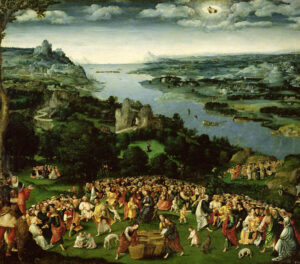
Following the news of the tragic execution of John the Baptist, Jesus sought quiet time. So, he took a small boat with His disciples to cross over to a deserted place near Bethsaida. But the crowds would not be left behind; tracking their path on foot around the northern edge of the Sea of Galilee, thousands arrived at the landing site ahead of them.
John 6: ‘Then Jesus lifted up His eyes, and seeing a great multitude coming toward Him, He said to Philip, “Where shall we buy bread, that these may eat?” ‘
Andrew said: “There is a lad here who has five barley loaves and two small fish, but what are they among so many?” (John 6:9 NKJV)
Jesus had everybody sit down on the grass. Taking the loaves and fish, He looked up to heaven, prayed, broke the bread, and began handing it to the disciples to distribute. Hands kept reaching out, baskets kept filling, and the broken pieces multiplied until every single person—some five thousand men, not counting women and children—ate until they were completely satisfied. Afterward, the disciples gathered the leftovers, filling twelve heavy wicker baskets—one for each disciple.
In the words of Isaiah: “If you are willing and obedient, you will eat the good things of the land.”(Isaiah 1:19 NIV)
To truly appreciate the depth of this miracle, it helps to look through the eyes of one of history’s greatest theological minds: Charles Hadden Spurgeon (1834–1892).
He was a well-known figure in 19th-century London and preached weekly to a large audience.
When Spurgeon looked at the feeding of the 5000, he saw how God works in the lives of ordinary believers.
He said:
“The whole of the punishment of his people was distilled into one cup… But his love for his people was so strong that he took the cup.”
“Observe that Christ used the means that were at hand. He could easily have commanded the clouds to drop down manna, but he did not do so; he used the five barley loaves and the two small fishes. So, in the conversion of the world, God will use the means which are already in his Church. There is enough grace in the Church, if the Lord will but multiply it, to supply the needs of the whole world.”
Let’s turn our attention back to what happened at the end of that day. After the disciples distributed the food to the multitude, it was their time to be filled.
Jesus, teaching humility and stewardship, knew they were hungry too: “Gather up the fragments that remain, so that nothing is lost.” (v12)
In the economy of the Kingdom, those who pour themselves out in service are never overlooked. The servants who spent the day feeding others found their own hands filled too. Provision always comes from the Lord, but we always have to be willing to be in service.
Take a quiet moment today to step into that scene.
The miracle of the hillside reminds us that nothing placed in the hands of the Master is ever wasted.
- What small, seemingly ordinary resource are you holding back, assuming it is too small to matter?
- Where do you need Jesus’s blessing to multiply your efforts today?
- How can you step back and watch the abundance grow from a place of trust rather than anxiety?
Click here to read Pastor Arni’s Sermon “The feeding of the 5000 – Though you are small…”